

Monthly Archives: March 2017
Special Tea event at Cha Ginza

We will hold a special event at Cha Ginza at Ginza 5.
It is 3mins walk away from our gallery.
You can enjoy green tea with our selected tea bowls by young potters.
'Cha Ginza' is a branch of Uogashi Meicha - a long established tea specialty company.
March 21 (Tue) - 26 (Sun), 2017
12:00- 17:00
1 person 700yen.
50 people a day - First come, first served basis
5-5-6 Ginza Chuo-ku Tokyo
Cha Ginza - 3F
Our staff will be there too.
We look forward to welcoming all.
Please feel free to come.
Shoji Hamada: Flat vase, Kaki glaze, Green-drop type
Reply
Shoji Hamada 浜田 庄司
1894 Born in Kawasaki, Kanagawa prefecture.
1916 Graduated from Tokyo Insitute of Technology.
Entered Kyoto Ceramic Experimental Station.
1920 Visited England invited by Bernard Leach.
1924 Stayed in Okinawa and Kyoto after coming back in Japan.
1926 Began Mingei movement with Soetsu Yanagi and Kanjiro Kawai.
1931 Built ascending kiln in Mashiko, Tochigi prefecture.
1955 Designated as a Living National Treasure.
1968 Awarded an Order of Cultural Merit
1978 Passed away at the age of 84.
Motozo Sasaoka - Solo Exhibition
Rosanjin Kitaoji & Shoji Hamada - Two Masters-
We are showing various works by Rosanjin Kitaoji and Shoji Hamada.
Rosanjin Kitaoji
・Tea bowl
・Flower vase
・Painting
・Jar
・Plates
Shoji Hamada
・Tea bowl
・Large Jar
・Flower vase
Rosanjin Kitaoji 北大路 魯山人
1883 Born in Shimogamo Kitaoji, Kyoto.
1907 Began his career as a calligrapher in Tokyo.
1916 Wandered around Korea, China, Shiga, Fukui, and Kanazawa.
Returned to Kyoto.
1919 Opened his antique shop in Tokyo.
1921 Began ‘Bishoku club’ (Gourmet’s club) which serves his food with his
collections.
1925 Began ‘Hoshigaoka Saryo’. (Members-only restaurant)
1928 Built ‘Hoshigaoka kiln’ in Kamakura for producing dishes used in the
restaurant. His reputation rose as his works exhibited in department
stores and the restaurant.
1935 Started focusing on producing ceramics.
1936 Left the management of the restaurant.
1937 The first exhibition of his new works held at Ginza Kuroda Touen.
1939 The Hoshigaoka kiln was blisk holding about 50 staff around this year.
1942 Evacuation in Ishikawa prefecture. Produced lacquer ware there.
1954 Held a solo exhibition in New York, invited by Rockefeller
Foundation.
Visited U.S. and Europe.
1955 Declined certification of a living national treasure.
1956 Actively held exhibitions in Tokyo, Kyoto and Nagoya.
1959 Passed away at the age of 77.
Shoji Hamada 浜田 庄司
1894 Born in Kawasaki, Kanagawa prefecture.
1916 Graduated from Tokyo Insitute of Technology.
Entered Kyoto Ceramic Experimental Station.
1920 Visited England invited by Bernard Leach.
1924 Stayed in Okinawa and Kyoto after coming back in Japan.
1926 Began Mingei movement with Soetsu Yanagi and Kanjiro Kawai.
1931 Built ascending kiln in Mashiko, Tochigi prefecture.
1955 Designated as a Living National Treasure.
1968 Awarded an Order of Cultural Merit
1978 Passed away at the age of 84.
Shinji Suzuki - Solo Exhibition
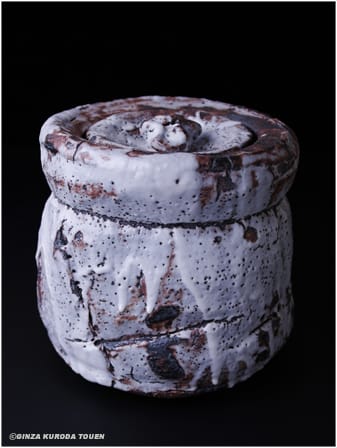
Lidded water container, Nezumi shino type
Shinji SUZUKI 鈴木 伸治
1976 Born in Gifu city, Gifu prefecture.
2000 Graduated from Tajimi City Pottery Design and Technical Center.
2001 Built a studio in Tajimi city.
2007 The first solo exhibition at Ginza Kuroda Touen.
(2007, 2009, and every year onwards)
Ryoji Koie - Solo Exhibition
Ryoji Koie 鯉江 良二
1938 Born in Tokoname, Aichi prefecture.
1957 Graduated from Aichi Tokoname Ceramic High School.
1962 Entered into Tokoname Ceramic Institute.
Received Contemporary Japanese Ceramic Award.
1972 Display at Florence international ceramic exhibition.
International Honorary Award at Vallauris International Ceramic Biennale.
1978 Display at The National Museum of Modern Art, Kyoto.
[Contemporary ceramic exhibition]
1986 Display at Pompidou Centre in Paris. [Japanese Folk Art exhibition]
1987 The first solo Exhibition at Ginza Kuroda Touen
(1992,1993, 2002, every years onwards)
1992 Became a professor at Aichi Prefectural University of Fine Arts and
Music.
2001 Received Oribe Award
2004 Retirement from a professor.
2008 Received the First Prize, the Japanese Ceramics Society.